
Searching Drew County Criminal Dockets
Search ARCourts gives the public its first look at Drew County criminal docket data. Arkansas courts on the Contexte case-management system feed it. Bring the case number if you can. A name search works too, but one common name can pull up many people. Before reading any charge, narrow the results to Drew County and confirm the court, the filing date, the case number, and that the defendant is the person you mean.
The online trail has limits. Felony records in Circuit Court live with the Drew County Circuit Clerk, Beverly Burks, at 210 South Main Street in Monticello, (870) 460-6250. Walk in or call on a weekday between 8:00 a.m. and 4:30 p.m. For a misdemeanor, a district setting, or a first appearance, use the State District Court clerk at 107 East Jackson Street, (870) 367-4420. If the Circuit Clerk holds the file, a fax or email request can also work.
- Identify Circuit Court or State District Court from the citation, notice, or charge level.
- Open Search ARCourts and choose participant or case-number search.
- Select Drew County and the correct court when filters appear.
- Match the case number, defendant role, charge, filed date, and status.
- Read entries in date order, then verify the latest future event.
- Ask the proper clerk for a plain or certified copy when needed.
Drew County Criminal Search Fields
Search ARCourts lets you look by participant or by case number. The name fields cover first, middle, and last. County, court, case type, and status filters may appear as well. Filters can shift. Trust what the screen shows you. Per the Arkansas Judiciary portal explanation, a public case record can list parties, the judge, filings, charges and dispositions, and future events. It may also show judgments and links to some documents.
| Search field | Best use | Check before opening |
|---|---|---|
| Case number | Most exact route | Keep official punctuation |
| First, middle, last | Participant search | Compare same-name results |
| County or court | Separate Drew County venues | Circuit versus District |
| Case type or status | Narrow a long list | Use only current portal labels |
The Search ARCourts portal lets anyone pull Drew County criminal case details from one statewide screen.
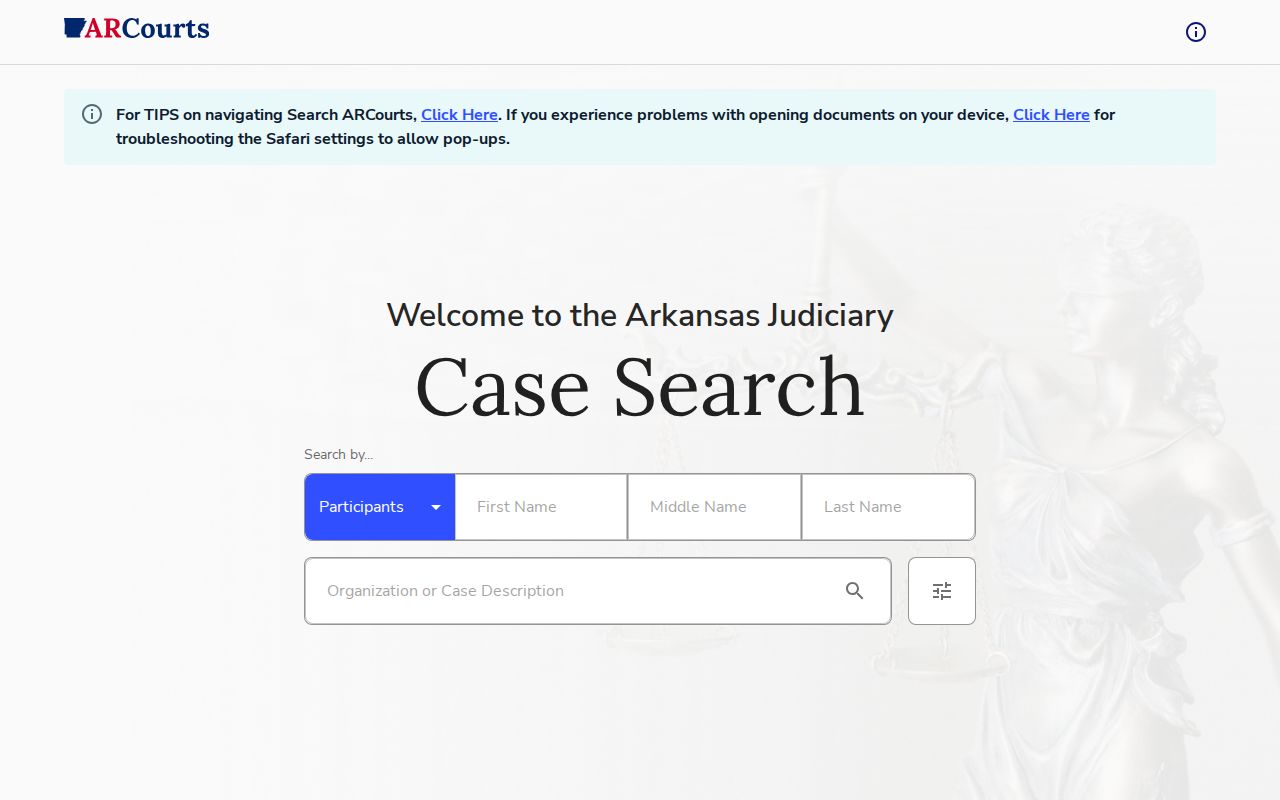
That official page confirms you are in the right place. Still, what it returns is a case summary, not a certified Drew County criminal judgment.
Inside a Drew County Criminal Docket
A Drew County criminal docket opens with identifying data and then tracks events in order. Expect the court, the judge, the filing date, and the case status. Attorneys and State and defendant roles may appear. Charges with counts, bond activity, pleas, motions, and orders may appear as well. Future hearings and the judgment may also show up. A link can open a public filing. A missing link proves nothing, though. The document may be restricted, not digitized, or held only by the clerk.
| Case number | The court's unique identifier, which should be copied exactly as displayed. |
|---|---|
| Charge and count | The alleged offense and each separately numbered accusation. |
| Setting | An arraignment, pretrial, motion hearing, plea, trial, or sentencing event. |
| Plea | The defendant's formal answer to a charge, not the final outcome by itself. |
| Disposition | The recorded result for a count or case, such as dismissal or judgment. |
| Future event | An upcoming action shown by the portal, subject to court confirmation. |
The court has published no local case-number format, so do not guess at one. Take the exact number from the notice or the portal rather than building a sample code.
Drew County Criminal Case Outcomes
One Drew County criminal case can hold several counts. Each count can end its own way. A filed charge is only an allegation. It is not proof of a conviction. One count may be dismissed while another ends in a plea or judgment. Read every charge line on its own. Then find the newest plea and disposition for that count. A case status like closed or disposed cannot do that work for you.
- Disposition
- The recorded outcome of a charge or case.
- Nolle prosequi
- The prosecution's formal choice not to proceed on a charge at that time.
- Dismissed
- A charge ended without the requested adjudication; the entry and order control.
- Bond
- Release conditions or security, not the final criminal result.
For the authoritative outcome, ask the Drew County Circuit Clerk for the judgment or certified disposition. A portal screen may help you find it, but the clerk's certification is what counts.
How a Criminal Case Moves
A Drew County criminal case can move through two court levels. The state district judge often runs the first appearance. That judge advises the accused, considers appointed counsel, and handles pretrial release. The finished paperwork then reaches the Circuit Clerk. It also reaches the prosecutor, the defense attorney, and the circuit judges who share Drew criminal work. Later Circuit Court entries may add an information, motions, notices, and plea proceedings. Trial activity and the final judgment may follow.
Docket flow: Filing → Arraignment → Pretrial → Plea or Trial → Disposition → Sentencing
The order is not fixed. Motion hearings and continuances add entries, and some cases end before trial. Follow the chronology instead of assuming every stage listed actually occurred.
Drew County Criminal Case Handoff
The Tenth Judicial Circuit administrative plan describes a split that matters in Drew County. For circuit referrals, the State District Judge handles warrants, first appearances, appointed-counsel decisions, advisements, and pretrial-release inquiries. An early event may happen at the district level. But the felony case belongs on the Circuit Court docket later.
What if Search ARCourts shows no Circuit Court case yet? Call the District Court clerk about first-appearance paperwork. Ask the Circuit Clerk about any new circuit filing. Give both offices the defendant's legal name. Include the date of the first appearance and any number on the paperwork. That check beats treating one empty search as proof that no Drew County criminal record exists.
Note: The clerk can confirm where a record sits. Only the court controls a release decision or hearing date.
Courts That Hold Criminal Dockets
Drew County Circuit Court is the general-jurisdiction trial court for felonies. It sits in the Tenth Judicial Circuit. Five circuit divisions share the work under the administrative plan. Division 3 keeps a Monticello office. Even so, follow the judge and division assigned to the case. Do not assume one judge holds every Drew criminal docket. Drew County State District Court handles the rest. It takes misdemeanors, traffic matters, local violations, and circuit referrals such as first appearances.
| Court | Criminal work | Record contact |
|---|---|---|
| Drew County Circuit Court | Felonies and circuit criminal proceedings | Circuit Clerk, 210 S. Main, (870) 460-6250 |
| Drew County State District Court | Misdemeanors, traffic, local violations, first appearances | District Clerk, 107 E. Jackson, (870) 367-4420 |
An appeal or a referral can move a Drew County case to a different court, a different clerk, and a fresh case number. Check which court holds the record now before you request a copy.
Drew Drug Court Docket Rotation
The Drew County Adult Drug Court is part of the local criminal system. It has a paper trail. It started as a pilot in January 2004. Under the Tenth Circuit plan, Circuit Divisions 1 and 3 trade off as the presiding division. The rotation usually runs every two weeks. The model is mostly post-adjudication, aimed at eligible first-time offenders the prosecutor recommends. Prosecutors, defense counsel, treatment providers, and community-corrections staff all sit on the team.
Drug Court activity still ties back to the underlying Drew County criminal docket. Entries that are public may list settings or orders. But never assume treatment material is public. Administrative Order 19 and other confidentiality rules hold. Drew County offers no veterans, mental-health, DWI, or juvenile specialty docket. Do not read those statewide programs into this one.
Drew Criminal Judgment or Transcript
Three records get confused. The Drew County criminal docket is the chronological index of a case. A judgment is the court's formal disposition and sentence. A transcript is the court reporter's word-for-word record of a proceeding. For a plain or certified judgment, ask Beverly Burks's Circuit Clerk office. A transcript request goes through the assigned judge's office instead.
Transcript rates are set by state law. The original plus two copies runs $4.10 per page. Each additional copy costs $0.50 per page. Photocopied evidence inside that transcript costs $1.50 per page for the original plus two copies. Each extra copy adds $0.50. Drew County posts no local criminal copy or certification price online. Before sending any funds, ask for a quote. Get a turnaround time, a delivery method, and payment instructions too.
Sealed Dockets and Public Access
Arkansas Supreme Court Administrative Order 19 sets the rules for access to court records. Public access means you may inspect a record. You can also get a copy during regular business hours. Remote access is permitted, not required. So a Drew County criminal docket can sit at the clerk's office. The statewide view may still look blank or partial.
What stays protected? Social Security numbers, financial account details, parts of birth dates, grand-jury material, juvenile information, sealed entries. Anything made confidential by law or court order is protected too. A confidential field may drop out of an otherwise public case. A fully sealed matter may vanish from view. The Arkansas Code portal holds the Criminal Record Sealing Act at sections 16-90-1401 and following. Sealing changes what the public can see. It is not guaranteed physical destruction.
Key access rules:
Administrative Order 19 sets the public, remote, excluded-record, and custodian rules for Arkansas court information.
Administrative Order 19.1 places redaction duties on filers so protected identifiers stay out of public versions.
Ark. Code §§16-90-1401 et seq. governs the state's criminal record-sealing process.
Asking for excluded material takes the formal, notarized process laid out in Administrative Order 19. No phone call, email, or counter request lets the clerk waive a sealing order.